Showing posts with label Google Forms. Show all posts

Sunday, February 3, 2013

Google Forms Updated

Google Forms has long been the middle child of Google Documents (now called Drive).  It has been under appreciated, long forgotten, but still a vital member of the Google Apps family.  That is until this week when it got what Google is calling "rebuilt" and "a faster, cleaner, and more collaborative experience."  More information on the release from Google.

Well, I have to say that Google has made significant strides in this new version to satisfy those of us that have used Forms for years.  I have long written about Forms on this blog, but these updates are exciting.  The layout is a lot more user friendly, it auto saves like the rest of the Drive documents, responses can be directed to a totally different spreadsheet , and URLs actively link to websites.  But don't just take my words here on the page as truth, let me show you:


Google Forms is very much updated, but it still leaves a few items to be desired.  For instance, where is the functionality to add in images?  There are scripts out there that assist us in doing it, but isn't it about time Google?  Also, math formulas?  These should be part of a WYSIWYG editor and not limited to text as it currently is.  What about the option to randomize questions?  Add a timer?  Some of these features are still very much needed.

At The FAIR School we have been consistently using Google Forms to collect teacher evaluations, enrollment information, quizzes, and more for years.  Also, don't forget the fact that you can now create a form from a current Google Spreadsheet.  For more information, check out this video from Google.  These updates only make Forms more of a player in the survey universe.  Try out the new version today and let me know your thoughts below.

Tuesday, October 23, 2012

New Icons in Google Apps & Conditional Formatting

The joy of using Google Apps for Education is that very often updates occur – like weekly.

However, every once in a while I login and notice that something is different and a little off.  Such was the case this week when I noticed that the icons for the Google Documents changed as well as a few of their colors.  In addition to that specific change, there are a few other helpful features Google has added in recently to Documents in particular.  Check out the video below for more information:


For more information on Docs, Sheets, and Slides (Google's new Drive names for Documents, Spreadsheets, and Presentation) check out this link to their support page.

In addition, some features of Google Apps for Education are worth repeating.  For instance, in Google Spreadsheets the use of conditional formatting is, I believe, an underutilized tool.  It can filter out responses and color code them with ease.  The only thing the user has to do is set-up the formatting.  Check out the video below on how to do that:


As you can hopefully see there are a number of uses for conditional formatting.  We recently used this at school to track which students had turned in important emergency record paperwork.  The ones that had turned it in received an "x" and their cell background turned green and those that had not turned in their paperwork the cells were blank and the background turned red.  It was very easy for instructors and office staff to quickly scan through the list and pull out those missing information.  The same can be used in a classroom.  With conditional formatting set up staff can quickly look and see how much re-teaching needs to occur or how many students actually understood the concept after watching a video.  A quick visual is always a good idea.

Google Apps for Education continues to amaze me with the power of their suite of apps.  Hopefully these videos have been helpful.  There will be more to come in the future!

Saturday, June 16, 2012

Summer Staff Training Here We Come

Summer time brings about thoughts of grilling out, time on the lake, and sleeping in for most.  However, for technology staff like me it also means the busiest time of the year.  We have roughly a thousand devices to re-image and configure over the next two and a half months, new software to implement, four summer programs to support, and if that wasn’t enough there is always the summer training for staff.  In our district we specifically ask our teachers and staff what type of training they are looking for and then go out and try to schedule what we can.  This summer I am particularly looking forward to a week of training, creation, and specifically integration of our iOS devices throughout the district.  Everyone will be coming together from Kindergarten through second grade, middle school teachers, special education, and even a few high school teachers to plan, dream, and really figure out how we can take our successful 1:1 iOS Program and make it even more effective.  Stay tuned for more information on this week in early August.

However, for staff that do not have iOS devices we also will be running a variety of training sessions throughout the summer.  We have done this a number of times before and have even used Google Forms for them to register.  Then to confirm their registration and send reminders we send out text messages to the staff.  Our principal had the idea roughly a year and a half ago to begin communicating with staff during the summer in a way that would be appropriate and easy for them – text messages.  They wouldn’t have to login it to their school email account and the messages would be kept short.  So far this process has worked out really well and we look forward to communicating with our families via text message more this fall.  Staff can never get enough training though so we are consistently reaching out and trying to find methods and ways for them to learn things on their schedule.

One way of solving this problem is through video tutorials.  As a school district we invested in a large video tutorial library through a third party a year ago, but then we decided after our one year review that not enough of our staff watched the videos to justify the cost we were paying.  Yes, we maybe could have done a better job implementing them into our environment, but we were also up against a staff that is stretched thin already and asking them to watch video tutorials in their free time seemed a bit silly.  So instead we are moving to create an in-house video tutorial library of important things staff need to know.  For instance: how to check your email, how to submit your grades, where the purchase requests can be found, and who to call when you have a technology problem.  All of these videos will be housed in the Videos app as part of our Google Apps for Education Suite.  The majority of them will be private and not viewable to the public, but all our staff will be able to access them with a click of a button.  It will be nice, slick, and a lot cheaper than our third party solution.  Probably the best part about this solution is that the content we create can be directed specifically for our staff.

However, every once in a while an opportunity to assist with staff development comes up and it is just to good to pass up on.  Such was the case when Tyler Hellemann (@MrHellmann), a cohort member from my UNI Masters Degree Program, sent me a message asking if I wanted to help him create a Google Form video.  Of course I agreed and we set off creating a collaborative document with an outline and parts of the script.  We decided early on that we wanted to complete the presentation together, but then after looking around and trying a variety of different tools we decided it would be easier to just film it separately and then put the two pieces together.  So that’s exactly what we did.  He used Screencast-o-Matic to capture the audio and video on his end, exported it, and then sent it to me.  I used Jing Pro to capture my audio and video, exported it, and then dropped both pieces into iMovie.  After a little tinkering we came up with this video:

Clearly this video isn’t going to win us an Oscar or Emmy anytime soon, but the content about how to use a Google Form hopefully got across.  We thought it did and that’s why we will be using this video during our summer and fall technology trainings at our respective schools.

Please enjoy this time of year – whether you are imaging computers, training staff, or hanging out on the lake – because summer is here!

Saturday, March 12, 2011

Google Apps for Education & Forms

Just over a year ago we began a shift from our old email services to Google Applications for Education. At times this shift has been hard and confusing, but once all the nuts and bolts were ironed out everything has worked very smoothly. Key to this process was allowing our staff members try out, implement, and discover all the unique features of Google Apps over last summer. When they returned we pushed them to use Google Sites for their teacher website and Docs for a variety of internal forms and discussions among colleagues. We also used Google Calendar for all those appointments we seem to have each and every day. This transition has gone very well and the success continues to astound me. A few of our innovative uses:

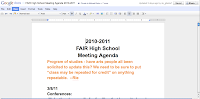
-Conferences: The ease with which instructors now create collaborative documents with each other and then edit them in real time is incredible. This year was the second year that we have used a conference Google Document across the high school to share and schedule conferences for each of our roughly 150 students. The kicker was that we did it all at the same time and in the same document. We even used an online form to have parents electronically submit times when they would like to meet with staff (see the video below for more information).

-Bus Duty: After school we have consistently had a problem dismissing all of our students at one time. There are two tiers of busses and they don’t always all get there are the same time. Google Docs and Drawings came to the rescue and now we have a document that everyone accesses at the same time each day to see which buses have arrived. Then staff across the building can dismiss their students accordingly. It has worked out very well.

-Meeting Notes: We used to e-mail notes about a meeting to one another if someone missed for some reason. This is not the case this year because our meeting notes are being consistently updated in real time between both buildings. This has brought greater collaboration and understanding between individuals and teams. Since we have multiple buildings within our district sometimes we schedule meetings when some individuals that work at both buildings cannot attend - whether for conflicting appointments or the geographic location. Now staff members can virtually participate in a meeting even if they are not physically there by commenting and adding to a Google Document that is updated in real time. Unfortunately they do not hear the audio of the meeting (even though there are other ways outside and inside of Google for doing this), but they can still be part of the meeting. It has been incredibly helpful to have all of our staff members on the same page because everyone can look at the one meeting document. We even have our associate principal adding in thoughts on a high school meeting when she is stuck in another meeting across town.
Those are just a few of the ways that Google Apps has changed the way we run in our school, but probably one of the most unique features has been the additional training around one specific application: Google Forms.

Google Forms operates much like SurveyMonkey, but it is free. Think of anytime when you are trying to get information from a group of people, but you don’t have a quick and easy way to do that. Well, fear no more because there is a simple and easy way to do just that. Watch the short video below for an overview (click on the image):
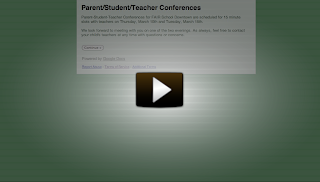
This was one of the very quick and easy ways that we have used Google Forms within our school. We have also created more complicated registration and application forms - even the one for the application to our school was built using this platform. We had over 1,200 parents apply and it was all handled easily, quickly, and was completely free.

Every time that you create a form it also creates a URL that is publicly viewable by everyone on the Internet that has that link. The permissions can be changed slightly, but in most cases you are going to want everyone to fill it out. That URL you can then post on your website, Facebook out, or even e-mail to everyone that you need or want to take your form.

These forms have completely taken our high school by storm. I have used them for quick comprehension checks and for more intensive exams that have taken the entire hour. Our math teacher is using these (in conjunction with a bit more math in her spreadsheet) to actually have the students take the quiz using the form and then it will grade the student’s quizzes and provide her with their scores. In our world history and upper level English classes students are doing their own self grading of essays using this format. Each and every time our instructors are getting real time, electronic, feedback from our students.
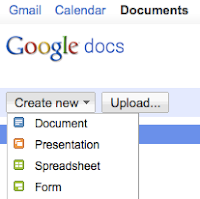
All in all Google Forms has completely revolutionized the way that we get information from parents, students, and their families. However, the best news is that even though this specific app is part of our Google Apps for Education domain it is something that even if you can access. Just login to your Gmail account and click on Documents. Then create a new document and select Form. It is that easy.

Want to know which week this summer is best to plan a vacation for your family? Create a Google Form. Once you start I guarantee that the ideas on how to use them both professionally and personally will not stop.